What Is ElevenLabs?
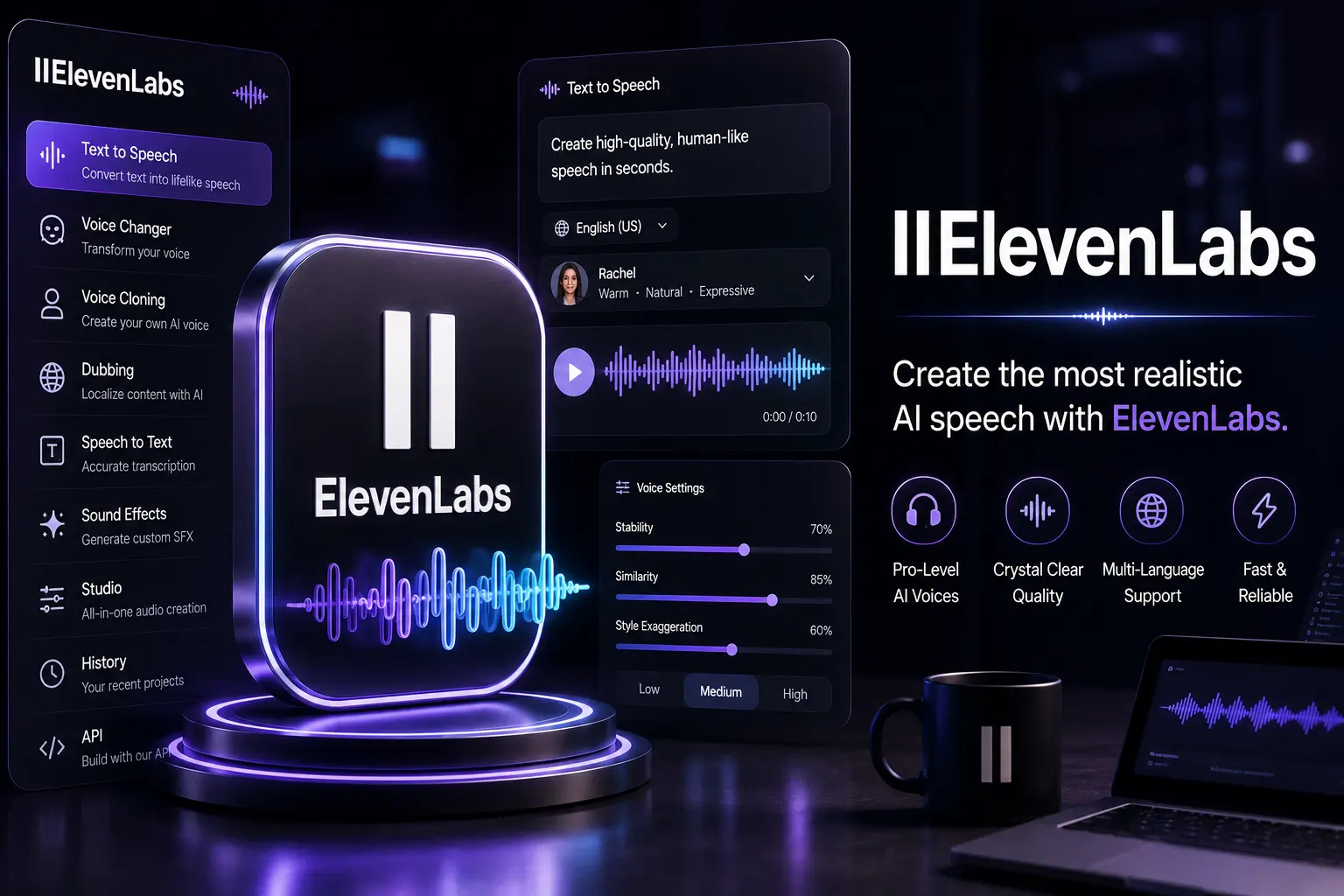
ElevenLabs is a voice artificial intelligence platform focused on natural-sounding text-to-speech (TTS), expressive narration, and voice cloning. By 2026 it combines advanced neural synthesis models, editing and production tools, and integrations that make it practical for creators, publishers, game studios, audiobooks, and enterprise use.
Why Creators and Teams Choose ElevenLabs
ElevenLabs stands out for three reasons: realism (natural prosody and clarity), control (fine-grained voice and style tuning), and production workflows (batch rendering, chaptering, versioning and API access). These strengths make it a popular choice where high-quality audio must be produced reliably at scale.
Key Features
- Expressive TTS — multi-style, emotionally-aware speech with accurate pacing and emphasis.
- Voice Cloning & Character Voices — create custom voices from short reference recordings (with consent workflows) and maintain multi-voice projects.
- Studio & Editor — timeline-based audio editor, batch export, noise reduction and style controls for emphasis, pauses, and breath sounds.
- API & SDK — production-grade REST APIs and SDKs for server-side rendering, streaming lower-latency speech, or integrating into apps and games.
- Localization — support for many languages, accents and localized pronunciations for names and terms.
- Safety & Consent — explicit voice consent flows, watermarking, and abuse-detection tooling for commercial voice cloning.
1. Voice Quality & Control
Voice quality is the core product. ElevenLabs’s models prioritize natural prosody and intelligibility: you can control speaking rate, pitch, emotional tone, and granular timings. The studio supports like tags for inline control and preview before rendering.
Practical tip
When producing long-form narration, break text into paragraphs and preview short segments at the target sample rate — small edits to punctuation and markers often produce outsized improvements in pacing.
2. Voice Cloning and Rights Management
Voice cloning is powerful but sensitive. ElevenLabs provides workflows for collecting consent, verifying ownership, and creating managed voice assets that can be shared within a team. For public or commercial use, maintain signed release forms and track voice metadata (owner, allowed uses, expiration).
The platform also supports watermarking and fingerprinting to help detect unauthorized reuse.
3. Production Workflows & Tools
ElevenLabs's studio is built for production: chapter management, batch rendering (audiobook chapters, podcast episodes), audio post-processing (leveling), and export presets for platforms (MP3, WAV, AAC). Team features include shared voice libraries, project versioning and comment threads linked to timestamps.
Integration examples
- Podcast pipelines: script → TTS draft → editor review → publish
- Audiobooks: chaptered rendering, human QC passes, metadata embedding for distribution
- Games: streaming TTS for NPC dialogue, with per-character voice assets hosted securely
4. API, Latency & Streaming
ElevenLabs offers both batch and streaming APIs. Streaming endpoints are useful for real-time interactions (voice assistants, IVR), while batch rendering is cost-effective for long-form content. Evaluate latency and concurrency limits when designing interactive experiences.
Practical tip
For live experiences, pre-warm voice caches and use short pre-rendered utterances for common phrases to reduce perceived latency.
5. Multilingual & Localization Considerations
Modern voice platforms must handle names, acronyms and domain-specific terms. ElevenLabs supports custom pronunciation dictionaries and phonetic overrides to ensure brand names and technical terms sound correct across languages.
6. Ethical, Legal & Safety Practices
Responsible use is non-negotiable. Best practices include:
- Obtain explicit, auditable consent before cloning a voice.
- Keep a signed release and metadata for each cloned voice.
- Use watermarking and monitoring to detect misuse.
- Design user-facing disclosures when synthetic voices are used.
- Implement access controls and rotate keys for APIs to prevent misuse.
7. Quality Control & Human-in-the-Loop
High-quality audio production still needs human review. Recommended QC steps:
- Script pass: ensure punctuation and markup guide desired prosody.
- Micro-sampling: review short rendered clips before batch runs.
- Human polishing: record or edit any segments that sound unnatural.
- Final listen-through on target devices (mobile, smart speakers, headphones).
8. Cost & Plan Considerations (2026)
Pricing varies by usage model (per-minute, per-character, or compute-tier), feature access (voice cloning, priority rendering, enterprise SLAs) and support level. When choosing a plan, consider:
- Projected monthly minutes for batch rendering and streaming concurrency needs.
- Costs for voice cloning and managed voice assets.
- Enterprise features: SSO, audit logs, VPC/private hosting and data residency.
- Support and SLA expectations for production services.
Always request a clear TCO example from the vendor based on your expected volume and retention needs.
9. Integrations & Ecosystem
ElevenLabs integrates with publishing workflows, podcast hosting platforms, game engines, content management systems and customer service platforms. Use cases commonly combine script generation (AI copywriting), TTS rendering, and publishing automation.
10. 10 Professional Tips for Better Voice Production
- Write conversational scripts — read aloud while drafting to find awkward phrasing.
- Use short sentences for clarity and natural pacing in synthetic voices.
- Leverage platform markup for pauses, emphasis and breaths.
- Test voices at final output bitrate and target device to catch artifacts early.
- Keep a library of approved voices for brand consistency.
- Annotate scripts with context (e.g., 'announcer', 'soft') to guide tone selection.
- Batch-render variants and A/B test with real listeners for preference data.
- Use watermarking for public samples and keep private keys secure.
- Automate post-processing (normalization, compression) in CI for repeatability.
- Maintain a consent registry and log for any cloned or licensed voices.
11. Common Mistakes & How to Avoid Them
- Expecting a single pass to produce final-grade narration—iterate and humanize where needed.
- Neglecting proper punctuation or markup, which leads to unnatural pacing.
- Over-cloning voices without governance — retain strict usage policies.
- Failing to test across devices — audio can behave differently on mobile vs desktop vs smart speaker.
12. When to Use ElevenLabs
ElevenLabs is well-suited for:
- Pod casters and publishers who need fast, high-quality narration drafts and production tooling.
- Game and interactive-app developers who require character-driven voices with low-latency streaming.
- Enterprises that need scalable TTS with governance controls, voice assets and compliance features.
Practical Final Verdict (2026)
ElevenLabs remains one of the top choices for professional-grade voice synthesis in 2026. Its combination of voice realism, developer APIs, and production tooling make it a practical platform for creators and teams. However, responsible deployment — with clear consent, watermarking and human review — is essential when using voice cloning and synthetic speech in public or commercial contexts.
Official Link & Further Reading
For the latest capabilities, pricing and compliance information, visit:
✨ Visit ElevenLabs — Official