Executive summary
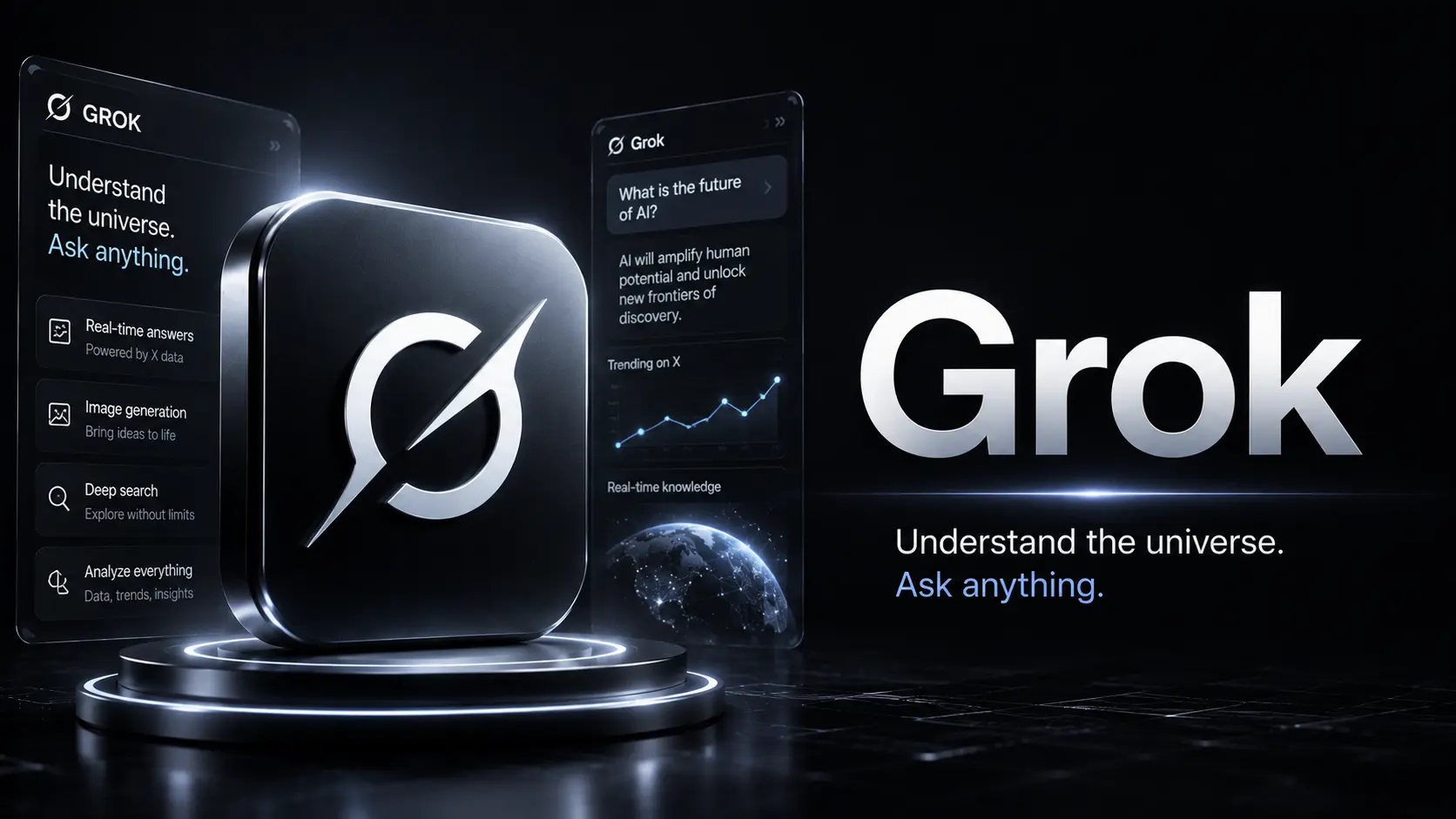
Grok is valued for speed, concise conversational answers, and developer-friendly interfaces. Use it for quick research, coding help, troubleshooting and exploratory data queries. For production-facing factual content, combine Grok with retrieval and verification layers and apply human review for critical decisions.
1. What Grok Does Best
- Fast, conversational answers that summarize web facts and common knowledge.
- Developer-oriented assistance — debugging tips, code snippets and concise explanations.
- Real-time grounding options and web-aware retrieval for up-to-date context when available.
- Compact, low-latency interactions suitable for chat-driven workflows and quick lookups.
2. Writing, Summaries & Long-form
Grok is optimized for short-to-medium summaries and idea generation. For long-form articles or authoritative reports, start with Grok to generate outlines and drafts, then move to a more conservative workflow (RAG + human editing) to ensure accuracy and depth.
Workflow
Outline with Grok → expand sections with retrieval and dedicated models → human edit + citations → final QA.
3. Coding & Developer Workflows
Grok is frequently used by developers for quick debugging, explaining stack traces, generating idiomatic code snippets and answering API usage questions. It is built to respond quickly and produce practical code examples, but always validate generated code with tests and static analysis.
Best practices
- Provide minimal reproducible examples when asking for debugging help.
- Request unit tests and edge-case checks for any generated function before accepting it into a codebase.
- Use Grok in an IDE or chat window as a first-pass assistant, not a replacement for code review.
4. Research, Web Grounding & Verification
Grok's strength is quick access to web-backed context. For research workflows, integrate a retrieval layer that returns source passages and include explicit instructions to cite or quote those passages. This reduces hallucinations and makes outputs verifiable.
Verification pattern
- Retrieve top-k passages relevant to the query.
- Pass passages to Grok and instruct it to quote and cite exact excerpts.
- Run an extractive verification step on any factual claims before publication.
5. Multimodal Capabilities
By 2026 many deployments of Grok support multimodal inputs: screenshots, small images and pasted logs. These features are useful for rapid debugging (stack trace images), document Q&A, and extracting data from visuals; pair them with OCR and structured extraction for reliability.
6. Files, Projects & Team Workflows
Grok can be integrated into team workspaces where private documents and code repositories are indexed for internal queries. Recommended practices: scope queries to project namespaces, keep audit logs of prompts/answers, and expose an approval gate for any answers that will be published or acted on automatically.
7. Agents & Orchestration
Grok can participate in lightweight agentic workflows — for example, suggesting next steps, invoking test runners, or preparing a draft PR. When enabling automation, enforce strict sand boxing, approval steps, and logs that record agent decisions and inputs.
8. Safety, Privacy & Responsible Use
Speed-focused assistants risk producing concise but incorrect answers. To manage this:
- Never rely on Grok alone for high-stakes factual claims—verify against primary sources.
- Implement data redaction and least-privilege access for private corpora.
- Log prompts with redaction of PII and maintain retention policies for audits.
- Use model-level safety controls and output filters for sensitive destinations.
9. Quality Control & Monitoring
Establish a simple quality pipeline:
- Automated checks: factuality tests, numeric validations and unit tests for generated code.
- Human review: domain expert sign-off for public or customer-facing content.
- Telemetry: track hallucination rate, user corrections, latency and cost per interaction.
10. Pricing & Plan Considerations (2026)
Grok offerings typically include consumer tiers for casual use and paid plans or enterprise contracts for higher throughput, private data integration and governance features. When evaluating cost, include:
- Query volume and expected concurrency for interactive use.
- Costs of any retrieval or indexing infrastructure for RAG.
- Engineering time for integrating verification and audit tooling.
- Enterprise features required: SSO, workspace management, data residency.
11. 10 Professional Tips for Using Grok Effectively
- Start with a clear goal: define whether you need a quick answer, code snippet or a research summary.
- Always request sources for factual claims when accuracy matters.
- Version prompt templates and store them near your project code for reproducibility.
- Use minimal reproducible examples when asking for code fixes — include expected behavior and test cases.
- Combine Grok with an extractive verifier when publishing facts or figures.
- Cache high-value answers for frequently asked internal queries to reduce cost and latency.
- Instrument user feedback (thumbs up/down and comment) and use it to iteratively improve prompts and retrieval.
- Limit automated downstream actions until a human approval gate is in place for production changes.
- Maintain an incident runbook for when the assistant returns harmful or incorrect outputs.
- Periodically re-evaluate model behavior after platform updates — model changes can alter output patterns.
12. Common Mistakes & How to Avoid Them
- Using Grok as a sole source of truth rather than a starting point for research.
- Embedding secrets or sensitive data directly into prompts without redaction or private inference.
- Accepting code or config suggestions without running tests and static checks.
- Failing to track which model version produced an answer — hurts reproducibility.
13. When to Choose Grok
Choose Grok when you need a fast, conversational assistant for developer productivity, troubleshooting, quick research and exploratory queries. If your workflow needs strict provenance, heavy compliance, or definitive, auditable factual output, pair Grok with a RAG + conservative verification stack or consider enterprise-grade assistants with stronger built-in audit features.
14. Practical Final Verdict (2026)
Grok is an excellent tool for rapid, interactive work: prototyping ideas, answering developer questions, and producing concise summaries. It accelerates day-to-day workflows when combined with verification and human review. Treat it as a high-velocity collaborator — fast and pragmatic — and build the supporting pipelines needed to make its outputs reliable for production and regulated use.
Official Links
For the latest product pages, docs and enterprise offerings, visit:
✨ Try Grok — Official